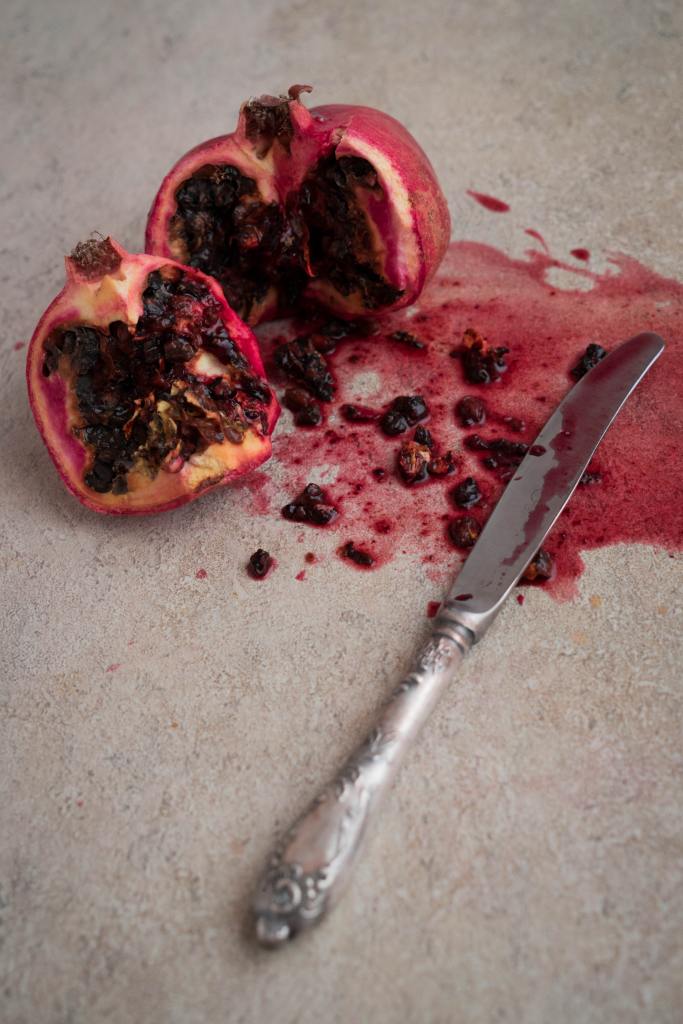
I told you I’m afraid of knives, yet you gave me that necklace Telling me it’s like day and night. On the outside, it’s a key; If you open it up, out pops the secret knife. You told me: “Keep it close to your chest, always.” Why? So it can Open up in my sleep, and stab me in my heart? You said: “That’s a good thing! It’s the key to our love. One for you. One for me….It’s not a murder. The knife carves out a spot for me.”
I told you, I’ll only open mine if you open yours. There you lie that very night, blade in heart, chain pulled tight. But I don’t need help with mine. I can open it myself.
When not teaching, Kaylee Stull writes horror. She attended CSU Long Beach where she obtained two BA’s in English. In her spare time, she hones her archery skills. Her social media is: @Kitkatstull.
I don’t live in homes, I live in storage (and on the verge of something greater.) As an anonymous passenger, or in a moving truck, between one fixed point and the next. From closed to open (liberation, absolute self) the transition away (departure) is most hopeful. My theory is that, especially during long journeys back to points of origin, when we are most altered by the other, the difference between that and our fixed selves is most salient. It is in the in-between that we are our home-selves.
Home is away from here, and home is on the way there.
Rosalind Aparicio-Ramirez (she/her) is a writer and artist whose work focuses on indigeneity, immigrant culture, the South, and the end of the world. She is pursuing an MFA at Hunter College.
You know that feeling you get when you lose one of the friends you love the most? I did. I lived with that feeling. I thought about her all day, every day. I thought about what I did, even though I didn’t know what I had done. All I knew was that it was wrong, whatever it was, and when you get to that place, your mind is always racing, trying to think of ways to make everything right, if they can ever be right again.
So I texted Maury about it. And a few hours later, he texted me back. And within moments, I heard him on the other end of a phone call.
“I’m interested in your case, Arthur,” he said. (My name is Arthur.) “I would like to have you and your friend, or ex-friend—whatever you wanna think of it as—on my show.” (His show is called Maury.) It was the happiest I had been in two years, three months, and forty-two days, so naturally, I said yes.
“Just so you know, though,” Maury continued—and thank God he did, and that I could remain at the mercy of that golden voice—“my show is ultimately still a reality show. We take some degree of creative liberty with the stories we feature. We’re committed to bringing you and your friend back together, but the audience wants drama, so we give them drama. It’s just a television thing, which you would understand if you were in my position.” Indeed, I couldn’t, as I wasn’t. So I agreed.
The next day… my friend called me. My heart swelled as much as it jittered. I hadn’t talked to her for so long, and I’d always dreamed of this moment. It was a chance to make everything right (not as right as Maury would in a week, but still). My hand shook as I picked up the phone.
“What the fuck have you done?!” she screamed. It was so good to hear her again.
“I’m making things right,” I responded.
“They won’t stop calling me or texting me. I block their numbers and I just get more. You’re such a fucking child, you know that? Why can’t you just move on with your life?”
I could tell she would be a natural for the show. I told her that I was sorry, but secretly I was elated. Maury was gonna save my life.
–
“Alright, Arthur, here’s what our writers have worked out,” Maury said. He went on to unfold a different take on our narrative, while preserving some key details: we had become close friends over the past five years, we cherished each other, and due to a tragic altercation, our friendship fell apart. Now this altercation, both me and Maury agreed, was something of a point of contention; it’s a very nuanced situation that was hard to deconstruct in a fair and concise way for a program of Maury’s character.
Indeed, I don’t know how much I want to get into it right now, so I’ll stick with the dramatized version that Maury presented me: when I went to visit her for a weekend, I recorded a video of myself rubbing my testicles on everything in her house. (He assured me little clarification for my motives were needed for his audience.) Since my friend gave permission to this account of our backstory, I complied. I am nothing if not flexible, after all, in the name of resurrecting friendship.
We were the second guests on the day’s episode after Maury caught up with that fat kid who ate sofa cushions, so I knew a lot of people would tune in. I could tell from our fortunate placement that Maury, indeed, cared about my case. For me to be so vulnerable with him, I theorize, was what drew him to me—it is the mark of a good human to see someone struggling and offer them the compassion and privilege of appearing on a widely-syndicated daytime talk show.
Even so, backstage, I was nervous. When you’re in that studio, it’s like you’re taken over by a spell. Every word earns you woops or jeers from the audience, and no in-between. I also think it’s fair to say, within me and my friend’s new narrative, that I was cast as the ostensive “problem,” a serial ball-rubber, which is perhaps not the most ideal position to be in. And as I listened to the audience shriek at my friend’s recount of the story, and then holler at the video they filmed of me rubbing my balls all over her apartment (it was a fake apartment that I went to for the shoot, don’t worry), the fear just kept sinking in, more and more. All I could think was, what am I doing? And it’s silly, in those moments, how anxiety can blind you and convince you that you’re doing the wrong thing, even when it’s so obviously right.
Every muscle in my body quivered as I waited behind the curtain to step onstage, and to face the ire of this committee. But when it was my time to shine, I realized that the only way to win this audience, and indeed rectify my friendship, was to be exactly who they wanted me to be. I embraced the narrative; I walked out to boos and hisses as I yelled for the audience to shut their bitch-mouths. I taunted them, I told them that they don’t know me, and they didn’t understand my life story. It was a spectacular performance,
fueled by complete devotion, for if I refused to commit to this, how could my apology be interpreted as sincere? I did this for her; even if I acted as if I were hypnotized by the sensory pleasures of a good ball-wipe, my remorse was sincere. And to her credit, she played along too: she responded to each of my words with the sort of superbly-acted recoil that strikes one as deeply naturalistic. We were brilliant scene partners.
At a certain point, I saw some people waving off-camera, and I knew that our segment would soon be over. Maury dialed us all back in with a simple question, guiding us to our denouement: “Arthur, I think it’s clear that you’ve made an absolute scene for us, and you seem to show little regrets about your action. So why are you hoping to apologize for your actions?”
I thought for a moment. Was it to make things right with my friend? Of course it was. That was all that I wanted from the start, and all I’ve wanted over these past two years, three months, and fifty-one days. But at that moment, all I thought was that I had to make the right character choice. I sat back in my chair and cocked my head to the studio lights. “Because I have the balls to apologize.” From the corner of my eye, I saw Maury nod, beaming an understated but celestial smile.
It was there, though… that moment haunts me a bit. Why did I say that? Did it even make sense to say? Was the pun worth it over just… breaking from the narrative and speaking my heart? I felt the progress that I’d made with my friend burn to the ground. Was I enabled by Maury and the audience? Arguably. But I pin the blame to myself. I let the fiction supersede the reality—it was as if losing my friend all over again.
Of course, contractually, she had to accept this apology for our segment to properly end, so she did. She told me she wanted me back. She told me that she had never stopped thinking about me, either. Even if I knew she didn’t mean it (she made few deviations from the script), I heard those words in her voice, and we exchanged a hug as Maury and the audience applauded. I knew it was fake, but for a second, everything felt real.
We never talked again. I stopped trying to reach out. But sometimes, on a particularly rough day, I’ll pull up that Maury episode on my DVR, and I’ll fast-forward to that moment. I’ll hear those words, and I’ll rewind, and I’ll hear them again. It’s strange the sort of things that mend the heart. It’s strange what makes you feel okay in the end.
in loving memory of Maury (1991-2022)
Matthew Dunko is a comedy writer based in Chicago. You can follow them on Instagram @mattdunko.
In our last hours on earth the sun looks like a half baked pie; the womb of a midnight mother concealing her child from the dangers of the world; it looks like protection, a foamy blanket bathtub sing along; rubber ducks count them one two three; like children leading a line through life; hands burning; like stretch marks; like telephone wires with hanging shoes; taking away a life before it started; rising to the surface; clouds; like brain matter scattered down the highway; like a bad accident; one too many moving parts on the clock that look like times up!
Julia Gobes is a student at Adelphi University on Long Island and emerging poet/creative writer. Her work has been awarded The Donald Everett Axinn Award for Poetry.
They came in the middle of the night, nothing but a rag of dark strands floating in the air, looking for someone to snatch, take away, and pull into the penumbra of the starless skies.
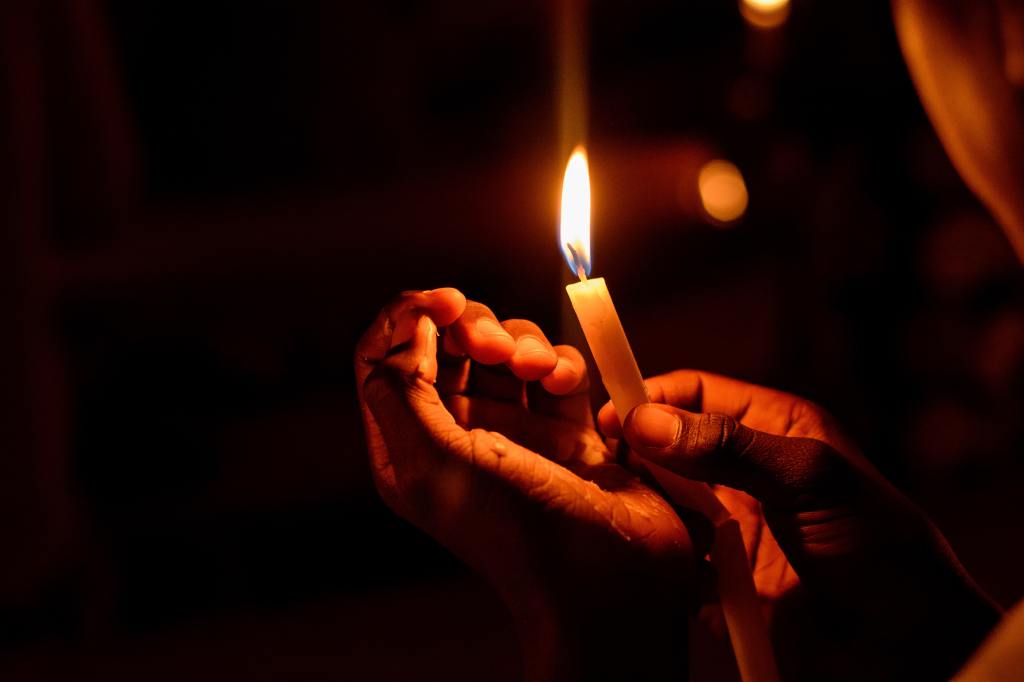
We knew they were coming. They do every year. And like every year since I can remember, our parents have left us outside with nothing but a candle. We huddled around it, burning our eyelashes, trying to stay out of the dangerous night. Last year they took Carlitos, the baker’s son. The year before they took Lucy, my best friend.
This year was my turn.
Alex V. Cruz is a Dominican speculative fiction writer and recent graduate of Clarion West. Discover the writings of Alex V. Cruz on Instagram and Twitter @Avcruzwriter.
Last year’s Valentine’s gift, a box of bananas. 12 bunches of remember you must die turned to bread. And the aging. Oh, the aging. The spilling of coffee onto the floor over and over. The year without water. Instagram memorials and [REDACTED] living forever online, gifting us discount codes and self-portraits. Curation that looks like comfort now, like that’s peace, like that’s recollection, like, if being remembered is just misplaced restlessness, then what else is there to say?
Meg Lubey is a visual artist and writer currently residing in Cleveland, Ohio. You can find out more about Lubey on meganlubeyart.com. Insta: megan.lubey Twitter: meganlubey
Zorb balls bumping into one another, a different kind of social distancing.
An object, scientifically and emotionally, when he sees me, I am a lamp.
Oppression naturalized as nostalgia.
Veronica Good is a poet and fiction writer. Her work has appeared in Archarios, Tempo, and Scapegoat Review. When she isn’t writing, she is taking care of her plants and her Burmese python Fitz.
i stitch one answer to the next; i make a seam with something
unorthodox. countless, i say – in a dress mimicking the moon.
in one of my memories,
i’m at the edge of a room filled with stalagmites & blood, in
a pool of mixed paroxysms. my mouth’s filled with gravel & the air, dense with salt water. i don’t pick up my tooth.
i leave it there. no white tissues. i get up slowly & bang hard.
hard on a wooden door is a 3 year old’s fist, curled up
like a sleeping dog.
Akubudike Deborah is an emerging poet and lyricist. Her works have been featured in The Rialto, Brown Sugar Lit Mag and elsewhere. She can be reached on Twt: @akubudikedebbie; Blog: adpoet.home.blog.
A burr caught in my belly, a bee above by my head, a puddle staining my legs, a squirrel squawk tucked in my ears, a downed tree trunk under my paws, a wind swaying my fur, a leaf swept along on my beard, a crush of acorns echoing on the forest floor.
Owned by two well behaved and hilarious terriers, good music, funny friends, nature and the ocean.
I will not trouble you with citations. All I can do is submit to you my thesis, which goes something like this: having been raised under the shadow of a tyrannical father, my particular syndrome of neuroses––my cloying, self-effacing wispiness of mind––can be cured only by a radical and protracted refusal to comply. And to this end, I propose a longitudinal study in the therapeutic effects of contrarianism.
INTRODUCTION
On my sixth birthday, my father brought me to Dairy Queen to pick up a Reese’s ice cream cake. The man in front of us in line had a tattoo of Spiderman web-slinging across his calf. “Dad, look, Spider-Man!” I blurted out. Hearing this, the man turned around, smiled, and fired an imaginary web out of his wrist. I laughed out loud and fired a few webs of my own back at him. The man chuckled and then turned back towards the counter to order. As soon as he did, I felt my wrist caught and crushed in the vice grip of my father’s massive, calloused claw. He dragged me back to the freezer, into which he deposited my ice cream cake, and then led me out of the store.
What I had just done, he informed me as we drove home, was abnormal. Over the years, my father was quick to point out other examples of abnormal behavior that I unwittingly exhibited. Coloring the rubber tips of my Chuck Taylors with green Sharpie: abnormal. Picking dandelions during a soccer practice: abnormal. The hemp necklace my middle school girlfriend made for me: egregiously abnormal.
Abnormality was far from the only sin of which I stood guilty in my father’s eyes. I was also lazy, sneaky, dishonest, manipulative, blasphemous, and intellectually incurious. But none of these held a candle to my most grievous fault.
“The boy contradicts me at every turn,” he complained to anyone who would listen. “He does it just to spite me.”
METHODS
The first experiment happened by accident.
One evening, during my first semester in a graduate program in Clinical Psychology at a Very Prestigious University (it doesn’t matter which), I was riding the bus back to my apartment. Thirty minutes into the ride, I was irate to find myself still pinned to the window by some old greybeard’s enormous shoulders. He and I were the last remaining passengers. In such cases, it is customary for the passenger in the aisle seat to shuffle over to the opposite row, allowing both passengers to enjoy more space.
I knew that this particular greybeard was a history professor. He taught in the same room as me. I had seen him giving out fist-bumps to his students––an unbecoming affectation for such a very old man.
“Beautiful afternoon,” he suddenly remarked.
I made no attempt to clear my face of shock and contempt as I turned to face him. Social convention dictates that if one is to make small talk in public, one must do so at the onset of the shared experience. For example, if riding the elevator with someone, it is permissible to start a conversation the moment you step into the elevator, but if more than three seconds pass in silence, the remainder of the elevator ride should adhere to that precedent.
We were driving over a bridge, and below it the river was bright with flames of red and orange leaves spreading over its surface. I realized that it must have been the sudden appearance of autumn foliage reflected in the water that inspired Boynkins’ remark.
“On the contrary,” I replied. “This afternoon is absolute dog shit.”
Just then, the bus driver came to my stop, and without waiting for Boynkins to get up to let me by, I stood up, stepped over his fleshy thighs, and left him dumbstruck and, no doubt, feeling quite foolish.
DISCUSSION
I am now reminded of the words of a very famous psychologist (don’t ask me which one) who said that self-knowledge is paralyzing. Though I’m sure he was some insufferable graybeard, he was quite right. In this moment, I was indeed paralyzed by the awareness that even my fury doubted itself. Was I mad at this avuncular fool, or was I really mad at my father for subjecting me to customs that did not exist?
But at a certain point, one must rage against whatever is at hand.
Colton Huelle is a New Hampshire based friendly neighborhood fiction guy. His work is forthcoming or has appeared in the Los Angeles Review, SOFTBLOW, and The Prism Review.









 Unstamatic