Yet somehow alive, palpitating on spirits’ crutches
Dusk unfurling its sail as the sun grows thin and frail, melting in the glistening sand
Night tiptoes donning its tenebrous cape and I gaze
at the gleaming holes in the sky hoping to witness a shooting star
They don’t fall anymore dreading what if I made a wish upon them
I touched the periphery of green oasis once, Must be a dream
Why else would I be revolving in the same hamster wheel
In a prison of time and space rocking back and forth involuntarily
Chalking hash marks to count quarantine that began before the pandemic
I knock inside to hear the soul’s verdict, It’s stubborn, hope still flows in its veins…
Swati writes on mental health, nature & spirituality. Work published in various magazines including Inspire the Mind, The Sunlight Press, Stonecrop Review & more. www.twitter.com/swati2610
ISAAC JOHN STREET is an alchemist of verbs. While a long, lazy stroll on Bank Anthony Way, a modest suburb barely two minutes away and overlooking Isaac John, would be seen as a great trek (a bad word for someone walking long distances without a transport fare in Lagos), on Isaac John Street, a formerly colonial and residential street but now fully commercialized, it becomes a leisurely walk or exercise to burn calories. A walk on Isaac John is appreciated any time of the day, but more lovely when done just on the cusp of darkness where desire sometimes meets satisfaction.
A STREET IS A MEMORY. I take this walk once a year without a destination. The map lodged in my head; my legs a compass of their own. Asphalt to asphalt, I walk, bearing a heartbreak or a disappointment that won’t go away. The clatter of traffic and the wind left behind when a car zooms into a distance form a lyric in my head. Street of memories and secrets. The bad streetlights know the secrets I won’t tell on pages; the expensive restaurants I never entered know about my therapy sessions. This was the same street that hid my boyhood shame under the night sky when I saved transport fare from my mom by walking the distance to get groceries for late dinners.
EACH TIME I walk into Isaac John Street, I’m reminded of how impossible it is to describe it fully from the comfort of my bed. Like a lover, you only know the street when you are in it. There’s always something extra that’s not there the last time. A new mall. A new restaurant. A new club. An old house gone. Decades after the colonial lords left Nigeria, the street is still discovering itself, still experimenting with its looks to determine what works best.
THERE IS ALWAYS ABSENCE. A street is not only about the things found on it. It’s also about the things that are no longer there. Time sometimes makes a fool of us all, erasing the things that make us; it takes away friends, places and memories. You begin to speak of a place that once existed with such clarity and vividness only to discover that no one remembers what you remember. Makes you understand how madness works: a man with deep conviction and lucidity about his past, motioning, explaining something that was once real and touchable to him, but that people now think is only confined to his sick imagination. People always start a discussion about a street from its beginning, but my walk around Isaac John Street commences from its end. I came into it through the Lagos Country Club on Joel Ogunnaike Street. So I notice immediately that the woman who used to fry akara on Saturday morning on the tail end of the street has been evicted and the man who used to fix bicycles beside her, and often chatted about wanting to pass down his skills to his son as his father did, is no more. The trader and artisan used to serve as bearings to strangers seeking directions on the street. “Drive into Isaac John, you will see a man repairing bicycles, move forward a bit, you will see Sweet Sensations.” This was before Google maps and smartphones.
A FRAGILE PRESENCE. A street tells us how we will be replaced. When we no longer live on it, something takes our place. The darkness on some parts of Isaac John Street, the bad streetlights that won’t get fixed, cover the marks of those who once lived here. The asphalt erases your footprints. The wind manufactured by fast moving cars wipes the dust from your feet. There are no sands of time. The street forgets. People remember. I remember Chimezie, my classmate who lived on this street several years ago. The place where his house once stood is now the spot of a fast food restaurant known as Sweet Sensations. I remember we played football together in school, because playing football was all we needed as kids to be friends. But Chimezie did more; he brought to class sometimes an edible nut with a fibrous covering which we all called “fruit” and until this day I do not know the appropriate name for it. If you wanted “fruit” (tropical almond) you had to be on the good books of Chimezie while it’s still in season. We took for granted that Chimezie lived on Isaac John Street and accepted his claim that his father owned the big house even though he never dropped Chimezie off in a car but hand delivered him to us every morning in school like groceries. His father looked old, ragged and sometimes in a costume, and after seeing him so much in them it started to look like my school uniform. And Chimezie never introduced us to him or not when I was around. I never heard from him after they left Isaac John Street and this fast food restaurant is a reminder of him. As I walk past the fast food now, I wonder if his father wasn’t a trained security officer with the benefit of hindsight, and that the building couldn’t have been theirs. It is over seventeen years now, but I wondered if Chimezie left Isaac John with gladness, or if leaving in a hurry was a sign of mortification. Our presence on this street is shifting and temporary, and that, perhaps, is the final argument for our very existence in this world.
NIGHTLIFE IN ISAAC JOHN used to be quiet and lonely. This was the original plan. A girl could walk alone in the past without fear of predators. Isaac John is part of the Government Reserved Area, a city unto itself where the rich and powerful on the Lagos mainland come to live. Before the new monies in Nigeria started living at the Government Reserved Area (GRA), it used to be a refuge for expatriates, both colonial officers and merchants from Britain doing the work of God Save the Queen. The commercialization of Isaac John Street brought about Metro-Park, a nightclub that fascinated me in my boyhood. I used to imagine what went on under the blue and red lights that covered the men and women who trooped into it as if in need of salvation. Passing it now, it is a surprise how a place could lose its magic and mystery with time and regular use. Reminds me of our bodies.
IN HENRY VI, Dick advised that all lawyers be killed. If you were driving through Isaac John Street on a Friday night, or Saturday evening, you would totally disagree with the Bard of Avon’s character. All event center owners without parking space on this street should be hanged. This is the genesis of the traffic jam on Isaac John Street. It’s Wednesday night, there is no traffic.
WALK FASTER. I stand by the traffic lights that separate the first half of Isaac John Street from the second. In fact, I’m entirely no longer on Isaac John Street as the ground I am standing on is officially Sobo Arobiodun Street if streets possessed the international privileges of nations and borders. Sobo Arobiodun Street is residential, innocent but teeming with desires and willingness. There’s a darkness to the street that’s lifted like a curtain each time a car passes by. During the day, there’s a woman who manages a small roadside business selling roast corn and ube. She’s always there, under the sun and in the rain and has become an extension of Sobo Arobiodun Street. She’s not on Google Maps. There’s more to a place than landmarks.
I WALK ACROSS this boundary to the other side of Isaac John Street. There’s Cubana, a club, in front of me. Cars are parked too close to the road in the same way I sit when there is not much legroom for me on a bus and I have to colonize the aisle. The club is palatial in a way that suspends its charm. The club is newly built and replaces the stately, quiet building that used to be there. The previous building was small with a large garden, too small for the space in a way that seemed self-reprimanding, self-critical and self-conscious of its privileges and opulence. The club is everything Isaac John Street shouldn’t be: its design is magnificent in an unruly way, the architecture demands attention the same way some cheap paintings hang noisily on the wall. I do not imagine who or what is behind the gates of the club. I instead think of what used to stand adjacent to it. A series of telephone booths before the arrival of cellular phones to Nigeria. The booths are no longer there, children of my generation can scarcely remember a time when people had to line up to make a call in telephone booths the way one stands to withdraw cash from an ATM gallery. It faded in the early 2000s, and I probably should be unable to recall it too but for the fact that a lady used to bring me to the booths as her protection whenever she wanted to talk to her boyfriend in Germany. I was eight and served nuisance value against the many men who catcalled, if they were cowardly, and stopped her, if they had some substance. She’s beautiful, with an unusual light skin, almost to a point of paleness. People called her oyinbo, a term of reverence for a white man or woman. Some women called her mammy water, a term for a water mermaid, reminding her that her beauty was extraterrestrial and she’s not human. These names were their coy way of telling her that those whose beauty came from a benevolent spirit should not forget to be humble in the presence of other women’s husbands. Don’t steal our men. In a city where people are either black or fair complexioned, her shimmering paleness was impossible to hide on Isaac John Street. During these international calls, she had to be at the booth hours before the call to secure a line. The situation was distressing to the point where a government minister in charge of communication was asked what the way forward should be. He laughed and told Nigerians that the telephone was not for the poor. Because the rich had phones installed in their homes.
FOR ONE GLORIOUS, transforming moment, Isaac John Street repossesses its routine elegance, its blank purity. I am at Adam and Eve, a store that has been on this street for as long as I can remember. The whole GRA borrows something from Isaac John Street to fill their houses with. This is what the Adam and Eve store is for. It’s like a place you go to buy expensive plates and furniture to stock up your empty apartment. Not a place to be if you dislike posturing, pretentiousness and humbug. I look at the transparent store and the light that pours out from it also gives away the image of the people shopping. I am one that is fascinated by what people tend to hide and not the idealized version of themselves. The intimacy that comes from watching strangers who don’t care about you. It’s almost like war photography, isn’t it? The refrigeration of humanity at ground zero: a point where neither privacy nor dignity matters to the victims. They just want to survive.
ADAM AND EVE is open. A man and a woman take a tour of the household items on sale. I watch. The woman walks in front while the man accompanies her. It looks as if they had postponed this couple shopping for their new house for several weeks and the man is always claiming to be busy. He looks at the items she points to buy and nods. I doubt if he truly sees them. Smiling at the shop girls, they both seem to be performing the role of the perfect couple and at once disclaiming any deformities in their union in public and assuring each other that things are fine. They both need this marital exercise of faith, yet it seems only one person is glad to be there. She needs his love yet she is pissed at the perfunctory performance of it. The lady points to something else, lifts another thing and the shop girls hover around her field of vision, carefully taking out whatever the married lady’s eyes and mouth fall on. At length, they pay and walk to their car, with heavy utensils and breakable things like their relationship. The man’s interest has faded, his old self has returned as well as the old peevishness between them, and he now fiddles his phone for the LiveScore to the English premier league or whatever numbers on the Nigerian stock exchange. And by the time they drive away, the lady is already planning another trip to Adam and Eve store. Or the Ruff ‘n’ Tumble store with their kids. By the time they drive away, I have completed my empty wandering on this street and I think of when next I could return for my therapy.
THE NIGHT is old. I do not take the road by which I came. As I grow older, my life seems as unrecognizable sometimes as this street.
II
Isaac John Street is a decoy, a street I have adopted to supplant the one I truly belong to. There’s another street. I don’t mean for this to sound weird. Like a man confessing to his wife: “there’s another woman.” Before I knew the marks on Isaac John Street, I knew Mobolaji Bank Anthony Way. I was born there. But it is a street that doesn’t speak to me anymore.
It was on Mobolaji Bank Anthony Way that I first met Pip, the character from Great Expectations by Charles Dickens. We became fast friends. I read the book in a rush the first two days, then slowed the third because I was afraid of the loneliness that would envelop me as soon as I let go of this character. There was something in the book that pointed to Mobolaji Bank Anthony, something only Dickens could write. It was that description of the marsh country, the poor, and that juxtaposition of abundance that was within reach of Pip but the sadness that came with this journey to being a gentleman.
Chinekotam Yagazie is in his final semester of the MFA in Creative Nonfiction at Miami University. He tweets @coolharris5
Is just inside the Svanemøllen S-Train station. Its dull, chalky light shining over the bike racks, Like a B-movie celluloid ghost, its pallor draping every face, Through the cyclonic vortices of trash and fallen leaves. I start to say, almost embarrassed, I rode all this way For an overpriced microwave pizza & zero calorie Faxe Kondi But the screeching of air brakes from the station below Instantly erases my memory & I linger, Just perusing the Haribo & Skildpadder, surreptitiously Watching your face in the uncanny glow.
J.R. Barner is a writer, teacher, and musician living in Athens, Georgia. Reach out to jrbarner.tumblr.com or on Twitter @jrbarner2.
-inspired by “Tulsa’s Last Magician” by Willi Carlisle
i can’t claim to be a magician but i’ve been known to make magic with my words and weave together illusions with my teeth
using letters and syllables like building blocks in attempt to manipulate the meaning of life
to make those around me see what’s jumbled and tied together by the sinew in my neck preventing the words from slipping past my loom of a mouth
forced back down my throat, over my shoulders, down my arms and out through my fingers as everything tightens until the act of unleashing it through capillaries untangles
my thoughts are like the blood dripping from my fingers to the keys, my words flowing out like the prayers used to
before the sinew tangled so tight that all thoughts folded onto each other and believing and confusing became intrinsically entwined
now, the only time i’m certain i’m religious is when i hit submit on something i’ve worked hard on that one day might pay my rent
it’s hard to tell a story when everyone thinks the same and that’s why auburndale’s last poet left her home so fast
McKenzie Campbell is a recent college grad with a master’s in creative writing. She enjoys writing romance and horror. When she isn’t writing smut, she’s reading it. Twitter: @booksnbobbles
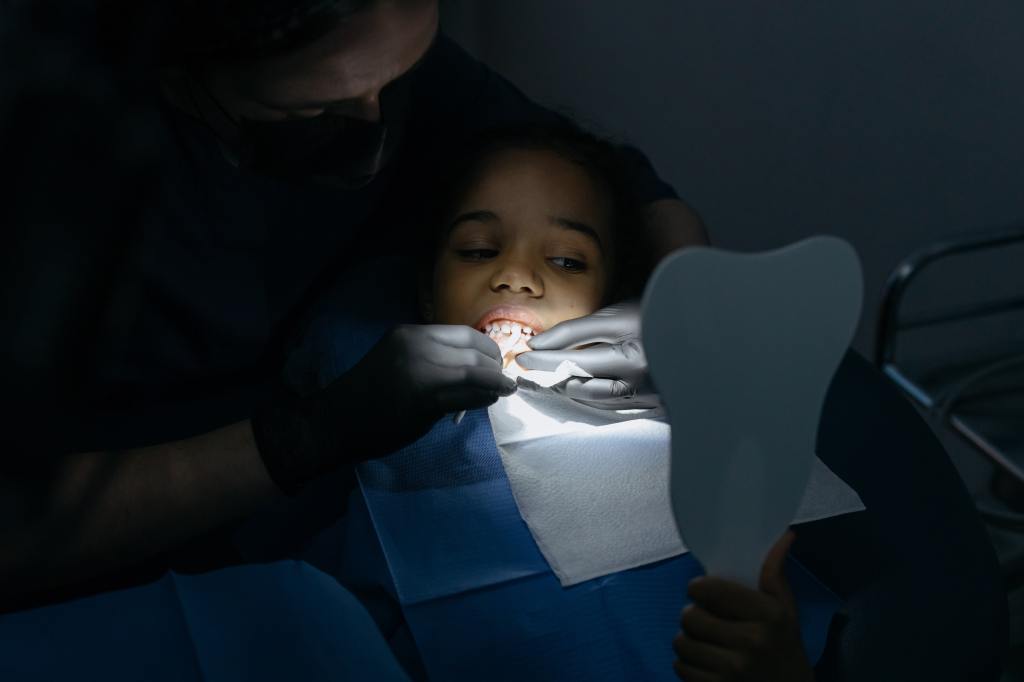
Like tiny soiled mirrors beneath the pressure of big, heavy shoes, Dana’s braces were so tight she thought they would crack her teeth; but the assistant wasn’t done. She’d only replaced the top ligature—and in a moment would return to finish the job.
Dana closed her eyes. Her tongue couldn’t help but to taste the brand new wire.
Her little brother was screaming from another part of the office. She heard a door open. Someone said, “Ma’am, would you come in here please,” and then the voice of her mother, “I thought he’d be fine,” followed by a long pause, and footsteps that went away behind her. “You said you’d be a Big Kid today,” her mother added a moment later, with a tone of annoyance, an embarrassed type of sympathy for the dentist.
But no one said anything after. Dana could only hear the sobs of her brother, the sniffs, the long and laborious sucks of breath, as though powering up for the second round.
“You have to brush, little miss.”
She opened her eyes. The assistant had come back and was watching her from above, behind clear goggles and a crisp white mask. She looked at a separate piece of wire, eyeballing it. “Huh?” Dana said.
“I said you have to brush. Three minutes,” the assistant replied. She looked at Dana, then at the length of wire again, measuring it with a shiny pair of cutters. “Your mom has a timer,” she asked, “for cooking? For eggs? Have her buy you a timer. Three minutes,” she repeated, “no less, okay?”
Snip.
Snip.
She put the cutters down on the tray. “Move your tongue,” said the assistant, placing the wire against her teeth.
“I brush,” said Dana defensively. The assistant pulled back and made a noise, like a groan. “Not well enough,” she replied, “not by a long shot. Move your tongue.”
“Three minutes?”
The assistant leaned back again. That must have sounded like a long time, Dana thought, coming from someone else. “You know what happens when you don’t brush?” From far away came the sound of a drill. “Hold him down, please,” a man said. Her brother started to scream. “You see,” the assistant went on, in reference it seemed to her brother, “that’s what happens. He needs a filling now. Do you know what a filling is?” Dana shook her head, her mouth still open. The assistant’s face blocked out the lamp above the chair. “If you don’t brush like I tell you,” she said, “you end up in need of a filling; because of the monsters.” Dana had slid down the chair a little. She tried to look up at the assistant, her eyes rolling to the top of her head.
“The monsters?”
“Yes,” the assistant said. “They live under your teeth. Right here,” she said, pointing with the sharp and metallic instrument at Dana’s gum line, “and here,” at a different spot now, “and right here. All over, see? And the monsters love when you don’t brush.”
“Why do they love that?” She found herself gripping the arm of the chair. Then the assistant was gone; or not gone, still in the room—not visible. Dana blinked a few times, the light above her hot against her face. Her brother wasn’t screaming anymore. The drilling had stopped; there were voices on that side of the office, but she couldn’t make out what they were saying.
“They get hungry,” said the assistant. “You leave bacteria on your teeth when you don’t brush; the monsters get big and strong from this.” She must have been looking for another tool: Dana could hear that she’d ripped something open, then the sound like silverware as it tinkered one against the other. “But the only way they can get to this food, this bacteria,” said the assistant, “is to punch holes through your teeth. That’s how they get out and feed.” Dana’s hands felt numb, and weak. Her jaw hurt. The assistant stopped messing with the swivel tray and glanced at her. “But if you brush, the monsters have no reason to hurt you. There’s nothing for them to feed on, so there’s no reason for them to punch through your teeth.”
“And they’ll go away?”
“Well,” said the assistant, “they’ll leave you alone. But they’ll always be there, ready to eat. That’s if you’re not diligent about your hygiene. So,” she swung back around, and pulled on Dana’s lower lip, “three minutes, okay? Move your tongue please.”
When she was done the assistant went away again; and Dana lay there with the newly formed pressure against her teeth.
She thought of her brother—maybe they’d gassed him (that was something they do, she’d heard, they Give You the Gas) and that was why he’d stopped his screaming. She closed her eyes and thought of those teeth monsters living inside her mouth; they were probably ugly, with bad teeth themselves, and big arm muscles and lots of crazy, messy hair from living in all the wet and stinking scum.
“So that was your brother,” a man said. Dana looked up; and this time there were three people above her. “Younger,” the man inquired, “or are you the baby?” The man had glasses on instead of goggles; his white mask was fixed beneath his chin. When he smiled, his teeth were bright and polished. The other two people, one on each side, looked the same as the assistant from before.
“He’s the baby,” Dana said. “He’s seven; I’m ten.”
“Ah, the big sister,” said the man. He took a seat on the rolling chair and spread her mouth apart with his fingers. “Looks pretty good. Nice work, Amber.” The assistant on the other side said Thank you. “So the big sister,” the man repeated, pushing himself away. “You know what that means, right?” Dana didn’t say Yes or nod her head or anything; she just looked at him. “You have to watch out for your brother,” he continued, his hands in his lap, “and that means making sure you both brush just as often and as well as you’re supposed to.”
“I brush,” Dana pleaded.
“I told her about the monsters,” the assistant said.
“The monsters, that’s right,” said the man. “The ones that live inside your teeth.” Then the chair she was in was moving, and a moment later she was straight up. “Your brother didn’t brush like he should have,” the man said to her, face-to-face, “and the monsters were eating his tooth. So I need you to promise me now you’ll look after him and take care of those bad, nasty monsters, got it? He’s the baby; he needs you, okay? All right, I think she’s good to go,” he told the assistant beside him. Then he got up and left the room.
#
Her brother sat in the front seat on the ride home. He kept rubbing the left side of his face, and complaining that he could hear voices from inside his mouth. Dana’s mother laughed. She said, “I’ve heard of that; it’s because of the filling.”
“It means you have to brush your teeth,” Dana snapped. Her mother gave a sharp, unappreciative look in the rear view mirror. “I got in trouble because of him,” Dana said.
“With who?” her mother asked.
“The man said he doesn’t brush; and then he said I don’t brush, even though I always brush.”
“I’m sure he didn’t mean you were in trouble,” said her mother.
“They’re really loud,” her brother said; and Dana replied, softly, “Yeah, those are the monsters.”
Her mother shot her another look. “Dana!”
“The what?” asked her brother, poking his head into the backseat.
“The monsters,” said Dana, looking at him.
“Stop it right now, you’re scaring him! What’s gotten into you?”
“Mom,” said her brother, “what did she mean—”
“It’s nothing,” her mother answered, “okay? She’s just teasing you.”
Dana put her head against the window. Her jaw was heavy, and sore; her teeth felt as though they could break at any moment.
#
This was two weeks after Labor Day. It was her parent’s anniversary and they’d gone out for dinner, asking Dana to watch her little brother until they returned. They’d be home by 11 PM, they said. It was 8:04 as they sat on the couch, watching cartoons. Her brother put his hand to his mouth.
“What’s wrong with you?” asked Dana.
“Nothing,” he said. He moved his lips up and down like a fish.
“Then why are you doing that?”
“I can hear them talking,” he answered.
“Who?” Dana had forgotten about the whole thing; but now—she remembered. “You mean—”
“I can still hear them,” he said, more irritated this time.
She turned to face him. She asked seriously, “What are they saying?”
“I don’t know. I can’t understand them.”
“Let me try,” she said, “open your mouth.” Dana put her ear up to his mouth, and tried to concentrate. “I think…”
“What?” he said.
“…I can’t tell.”
“Is it the—”
“Yes,” she answered, “I’m pretty sure. Have you been brushing?” His face scrunched up a bit. “I’m sorry,” he said, so low beneath his breath it was barely audible.
“You have to brush!” Dana said. She thought back now to what the man had told her, about looking out for her little brother. “What do I do?” he asked; and for a moment—she didn’t know; but what if, she wondered, his monsters would come for her? What if they ate all of histeeth and then devoured all of her teeth in the middle of the night?
And then mommy’s teeth.
Daddy’s teeth.
The neighbor’s, and the dog’s; the teeth of her friends at school.
Her homeroom teacher, Ms Quigley.
That must have been why the man had warned her, she thought. Her little brother’s bad and rotten teeth were going to get them all, eventually. Unless, as the man had said, she stopped them.
She got up from the couch with an urgency, taking him by the hand. “Come on.” Her brother’s palm was hot and wet. He asked what they were doing; she didn’t answer.
They went upstairs and stopped below the attic. The rope hung just enough to where she could reach it with a small jump, and the door fell towards them very slowly. But she couldn’t reach the wooden stairs. “Stay here,” she said, going into the bathroom; and she came back out with the step stool her brother used to see himself in the mirror. Now the stairs were reachable. They swung down with a thud. She turned to him and said, “Go up there,” giving him a shove on the back side.
“What?” he asked.
“Go,” she said again, “I’ll be right behind you.”
He went all the way up, disappeared for a second, then turned the other way and stared down at her. “Pull the light switch,” she said, and he did. She came to the top rung and grabbed the two side struts of the attic and hoisted herself to her feet. Then they stood there, looking around. There were a few old boxes, boxes of Christmas lights, and bags of sporting equipment; there were three rows of blankets piled four high near the rafters at the back, next to a wooden table and some chairs, stacked on top of each other. Beside the table was a tall, brown radiator.
“Come over here,” Dana said. She picked up the box of lights and set it on the table; he was standing next to her but she didn’t look at him. “Listen. We have to stop them,” she said, her tone more weighty than usual, “or they’ll get us all, see. They’ll get mommy, and daddy. Your friend, Todd. Everyone.”
“The monsters,” he said.
“The monsters. It’s too late for you, but we can save the others. Don’t you want to save the others?”
He put his head down. “What do we do?”
She walked over to the blankets and grabbed one; it had cartoon dinosaurs on it. Then she untangled the Christmas lights from the box. “Sit down on the blanket,” she said, “and face me,” as she unfolded the blanket onto the floor next to the radiator, “and give me your hands.”
“How come?” he asked.
“Just give me them.” He sat cross-legged, holding his hands out. Dana got on her knees and plugged the lights into the outlet next to the radiator. They came on in blue and green and red. She crawled back around to him, wrapping the opposite end around his right wrist, careful not to break the bulbs against his skin, let the length of wire stretch out before wrapping it around the foot of the radiator, then finished at his other hand. “Now I need to go grab something,” Dana said, her finger to her chin.
“No!” he said. “Don’t leave me up here!”
“I’m not,” she answered, “I’m coming back; but I have to go downstairs for something. Okay?” His face was scrunched again, those long and sticky breaths beginning to pulsate in his throat. She got to her feet and went down the attic stairs.
Dana wasn’t gone for very long, just two or three minutes; and when she came back up she stood at the top of the landing, and stared at him as he sat there; her poor, pathetic little brother, and those monsters now within him—soon to eat her whole entire family’s teeth. But by the man’s own instruction, she would put a stop to that. She went to her brother and knelt, laying the flat-head screwdriver on the blanket. She held the hammer firm in her right hand and checked his wrists. “I can’t have you moving,” she said. He blinked at her a few times, enough to produce the tears she’d come to expect. She wiped them away. “I don’t have the Gas for you,” she added, “but I have to save them. I’m sorry; I have to get those monsters out of you and crush them before it’s too late. Before they eat us all. Just look at your hands, at the lights. Think about the Christmas lights.”
“Please,” he said, voice wavering; he promised her he would brush. But there was no other way. Dana picked up the screwdriver and set it flush against his top front tooth. He was shivering, his temples sweating. “Do you—” she pulled her hand away; “—do you still hear them?”
He looked into her eyes. “I hear them in my mouth,” he said, finally, quietly; and Dana shook her head. She put the screwdriver back against his tooth, and the hammer made a curious whistle as it swung, many times, through the hot and fetid air.
The trouble with that is the limits to what I can say.
I can tell you that you have meant a great deal to me.
[As sandpaper means a great deal to the wood being ground
down to sawdust, falling to pieces, plummeting in spirals
to the cement, to lay there until swept away or rendered
stale, molded, in little mounds never enough to combust.]
L.M. Cole is a poet and artist residing in North Carolina. Her work has appeared or is forthcoming with Roi Fainéant, Corporeal, Bullshit Lit, The Bitchin’ Kitsch and others. Twitter @_scoops__
In the constant flux of horses and Dragons, many are the creatures whose sightings happen so rarely that they are considered closer to being legends than to be real. After all, not everyone had the chance to witness the landing of a flaring Phoenix descending from the skies with its might wings, or the arrival of a White Tiger ready to roar at the Moon to share songs about wisdom with the world, not even if one managed to live to be over a hundred years old.
Moreover, while lots of men and women bragged and claimed to have received the visit of a Dragon, often it was the case of an exaggerated lie, the encounter of a snake whose proportions became larger in the person’s mind and ego, in order to appear worthy of praise and respect for the simple fact that Dragons have decided to appear in front of them. Some have even altered paintings of snakes by adding legs on its bodies, effectively turning them into strange lizards, just to sell their point.
However, there is one creature which is considered to be rarer than all those, even rarer than a Dragon. Said creature is known in this area as the Golden Unicorn.
Despite the name, however, one should not immediately think about it as a horse with a golden skin and a sharp, shiny horn on its forehead. The peculiarity of the Golden Unicorn was that, according to the very few people who saw one and wrote that down, its body parts resembled those of other animals.
Its tail was sleek, with lots of fur on its end, similar to that of a bull. Its belly was the same shade of yellow as a crocodile’s. Its body, green and scaly, was compared by many to both a snake and a Dragon. Its mouth was decorated by two long barbels, like those of a carp. Then, its horn was tweaked and imposing like the ones on a deer’s head.
As people began to wonder why was the Golden Unicorn so similar to other animals, which had nothing in common with one another, there were wise scholars who tried to point out that such a creature had characteristics which made it comparable to those specific animals.
Like the bull, the Golden Unicorn roamed freely, with nothing on its path capable of bothering enough to either stop it or face it. Like the crocodile, it was able to walk on both land and water, being so gentle in its movements to not harm a single blade of grass. Like the Dragon, many beings feared and respected its arrival, rarely trying to cause any harm to it. Like the carp, much like said fish is able to swim against currents and waterfalls in order to reach its destination, the Golden Unicorn always made it back to its celestial place with safety, against any possible odds. Then, like the deer, it seemed like a majestic presence, a spectacle that people felt glad to have witnessed.
Another curious characteristic of the Golden Unicorn is that it is said to be engulfed in flames. However, it has always been unclear if those “flames” are proper ones, or if the bright sunlight wrapped around its body was so intense that people just assumed its body was completely surrounded by fire.
The reason why it was so rare to see one of them was that they only appeared on one of two specific occasions: the beginning of an important period, or its end. Many also say that it announces the birth or the death of an individual, but that was solely because they were so intertwined with the events that their mere existence was necessary for them to occur.
To better explain this, let’s talk about three of the last times the Golden Unicorn had appeared in this land.
There was once an old King, the type of ruler who was honest, gentle and kind to its people. His white beard was so long that it almost touched the ground, even when he was standing up to walk. For sixty years he had ruled, and he was now worried about what was going to happen to his Kingdom, once he had passed away. So much he worried that he barely left his throne room, even in days where nobody was requesting his advices or waiting for his orders.
Then, once day, while peeking through a window, the King saw the shining aura of the Golden Unicorn. It took him a couple moments to recognize it, but, once he did so, he felt warmth across his wrinkled old body. If it had paid visit to the Kingdom, then it meant that a period of peace and prosperity was on its way. Being aware of that, the old King celebrated with its people one last time, as he passed shortly after.
While a young woman was looking at the colorful flowers of spring on the hills close to her house, her mind was focused on what had become of her betrothed, who had left their town in order to enlist in the army. She was too preoccupied for him to even notice how beautiful the flower petals caressing her arms were.
In that moment, the Golden Unicorn appeared in front of her, as it even smiled at the woman. Whatever was happening far, far away, was over, as peacetime was upon them. Her beloved was going to return, and they were going to raise a family of righteous people, who would have brought good to others. Indeed, the man returned after a fortnight, as they finally celebrated their wedding.
So inevitable was the arrival of peace and happiness when the Golden Unicorn appeared that there was once a time in which a powerful warlord tried his best in order to conquer and destroy the capital city of his state. No soldier was able to defeat him, and his men were an unstoppable force, as they had reached the city walls, ready to destroy them.
Yet, before they were able to do so, the Golden Unicorn appeared from the clouds, walking towards the warlord. It felt so light as it passed through the soldiers, as if it was floating. All it took for the warlord was to see the Unicorn’s eyes once before he decided to retreat, having accepted his defeat. If celestial beings were against his victory, then he was only going to cause unwanted and unnecessary harm.
Those are just three specific events, but they all reflect how widespread it is that witnessing one has always been a huge deal.
There are many people nowadays who try to spread the rumor that the Golden Unicorn has returned. Only a handful of them try to do so in order to justify their actions, and another
handful say that because they hope to see peace once again before they are laid to rest, but the majority is just confused by the fact that not everyone is able to recognize one.
Who knows: perhaps, not even the old King, the young woman and the warlord saw an actual Golden Unicorn, but they still believed in it anyway, and prosperous times did follow after their actions.
Should you have the fortunate occasion of seeing once, remember that you are not encountering sorrow, but great omens. Do not believe that your choices are sealed, but be aware that you have made the correct ones.
And now, go ahead, and look up in the sky. Perhaps, you would recognize the scaly body, or the furry tail, of a Golden Unicorn.
An Italian university student who loves learning, writing and creating, because every moment is worth creating for.
Dear student who graduated ten years ago, This is Professor [EARSPLITING STATIC NOISE] emailing you in hopes that you remembered to finish that paper on finding all the symbols in all literature forever The paper needs to be sent to me in a file that has long since become obsolete. I will not take anything that comes in DOC, PDF, Open office, or any simple to use formats. I will not take any excuses. I don’t want to hear how your fingers have fallen off and replaced with snakes with you father’s face. Have a wonderful dream this semester
Jim Burdick is a writer living in Rhode Island, making his way into literary society by short fiction and humor alone. He is also a dog person. https://twitter.com/JimBurdickComic
He just wanted a publication credit. He was not going to encourage people he knew to check the story out. He wasn’t proud of it. He knew his story being self-referential and meta did not make it good, lend it any credence of value. He very briefly spell-checked. He tried to get it at least somewhat close to one hundred words. But that was it. No effort. No edits. Didn’t even sustain the whole each-sentence starting- with-‘he’ thing. Please. Skip to the next story.
Sam has been published by Banditfiction, Audio Arcadia, and is upcoming in the Syncopation Literary Review. He works as a bid writer in the charity sector and has an MA in Creative Writing.
CW: blood, gore, glorified evil (in the context of fantasy witches) (but it’s also a queer love story)
The witches washed their hair in blood Smeared each floor with slimy mud Their teeth to pointy daggers filed Their smiles alone made fear run wild. And smile they would, at every curse At every draft to make life worse And at their stories, tales of old At night by light of fire told. Young Dobra didn’t think them fair When those who helped people with care Would find their hearts devoured, while Their severed heads were drowned in bile. Young Vreda, on the other hand Though always Dobra’s closest friend Admired the heroes of that age And let her evil powers rage. When Dobra asked: “Won’t you be good?” Vreda said: “None of us should for weaklings know a dreadful end, don’t reach the glory I intend.” Next morning during witching class Vreda invoked a spell quite crass: From Dobra’s face tentacles grew— In shame, the girl withdrew from view. By dearest friend her trust betrayed That night she had a promise made: Not once again she’d harm a soul; To ward off evil was her goal.
Until their graduation rite The girls refused to reunite But then called Vreda: “Dobra dear, before you disappear, please hear: I should have told you long ago I wouldn’t cause my friend such woe. To me, appendages are neat A gift to make you look more sweet.” Now Dobra was with silence struck But pulled her friend into a hug How could her judgment be so wrong And curb affection for so long? When Vreda asked her on a date She knew this had been long delayed; They pledged to make a whole fresh start Both greatly changed by time apart. Since Vreda’s spell had hurt her so Dobra had vowed to comfort woe To cure the sick and bless the kind To make each evil deed unwind. Vreda’s vile sins became more cruel For her own sorrow was their fuel: What use was goodness when it made One cast away their wicked mate? And so each kept to her own view And neither from her aim withdrew To cause more pleasure or more ill As they lived, wedded, on the hill. The neighbors loved Dobra quite dear; All countries viewed Vreda with fear So they were happy, come the day A farmer spoke of his dismay. “Though Dobra blessed my crops last year I wait for magic to appear: they still look average at best so I feel cheated and distressed!” The witches met each other’s eye And giggles spoiled Dobra’s reply: Though she had blessed, her wife had cursed And all to balance was reversed.
Minerva Cerridwen is a queer writer from Belgium. Xyr novella The Dragon of Ynys came out with Atthis Arts in 2020. Find more of xyr short stories and poems via https://minervacerridwen.wordpress.com/







 Unstamatic