Many people believe that once we become unconscious during the process of dying, the sense of hearing is the last thing we lose. A recent study at the University of British Columbia lent some credence to this long-held belief. The researchers used electroencephalography (EEG) to record brain activity in response to sound from two groups of study participants: a healthy, conscious control group, a dying-but-still-conscious group receiving hospice care, and the same dying group after they became unresponsive. They found that several of the dying patients’ brains showed responses to auditory stimuli that were similar to the control group, even when they were literally at death’s door.
It’s this fascinating quirk of the human body that leads loved ones to sit for hours at the bedsides of the comatose and dying, chatting with them or reading to them, all with what research is indicating is the valid hope that their voices are reaching through the fog of unconsciousness.
But what does it mean when this supposed natural order ruptures and reorders itself? If the last thing we’re supposed to lose before we die is the ability to hear, what does it mean when our hearing goes first?
I suppose it could mean one of several things: too much exposure to loud sounds, old age, an infection, an injury, a hereditary malformation, to name a few. I got no such explanation two years ago when I lost all hearing in my left ear, only the word “idiopathic,” along with weeks of steroids and a normal-looking MRI. I’m dying in reverse. Piecemeal, but fighting every step.
No wonder I’m obsessed with zombie and vampire stories — the undead and the reanimated have held a fascination for most of my life. My childhood was filled with strange dreams and visions; I grew up sensing things that no one else could and experiencing déjà vu on a routine basis. I couldn’t have known then that parts of me would join the unavoidable transit toward death so far ahead of schedule, nor that I would claw against it with so much urgency, but that’s where I landed and where I hoist my battle flag. Like Persephone in the Greek myth, I surface from this puzzling-yet-familiar underworld every so often, only to get recalled as soon as I start to forget what I am: the main character in a warped superhero origin story.
This is my hill, and I’ll be dying on it.
I’m no stranger to hearing loss. I grew up with a dad who developed conductive hearing loss as a child. From the time I was old enough to carry on a conversation, I understood that my dad couldn’t hear me if I addressed his right side. Looking back, I wonder how many times he just smiled and nodded or offered a passive “mmm-hmm” without ever knowing what I or anyone else had said to him.
The man had issues. Enough, as the wry insult goes, to open a newsstand. His issues were the vertebrae of a generational curse visited upon my brothers and me; a curse that was likely passed to him from his parents. After all, these things are difficult to isolate. You can pick up the scent of it only to meet yourself turning inward in an ever-tightening spiral until you’re so dizzy your body finds the ground before your eyes do.
A spiral. Like the cochlea.
Part of my father’s pathology (characterized as narcissistic personality by some of the therapists I’ve visited since the age of 19 in my own quest to break the curse) involved embellishing the truth and rewriting history — his own and that of the people in his orbit. If there were reliable witnesses to a particular event, it was easy to spot his lies in the retelling. But if the witnesses were absent or their perspectives otherwise lost, we learned to take everything Dad told us with a grain of salt, or several.
One story he told was the tale of how he lost his hearing in his right ear. I find it hard to believe that he embellished this one much because it doesn’t make him look particularly smart or talented, but I’m putting the saltshaker on the table anyway because I have no way of knowing for sure. He told us he went swimming in a drainage ditch as a boy and developed a severe ear infection, or perhaps a series of chronic infections. The result was that one or more of the auditory ossicles in his right ear (those three tiny bones that move sound from the eardrum to the cochlea and on to the auditory nerve) fused or malformed somehow, and sounds could no longer travel past his eardrum.
When he was 66, he underwent surgery to replace the malformed ossicles with artificial ones and restore hearing but I’m not sure how much good it actually did. He had refused a hearing aid for decades because he didn’t want to look old. This surgery was probably attractive to him because it meant he wouldn’t have to wear any visible external equipment, but he struggled post-operatively with certain sound frequencies and volumes.
When I lost hearing in my left ear, almost one month to the day after his death, the spiritual, woo, it’s-all-connected part of me wondered if my dad was playing some nasty joke on me from the other side. I wouldn’t put it past him — he was as mean as he was dishonest. While I struggled with vertigo and almost unbearable tinnitus, I mumbled curses under my breath and screamed at him in my heart.
I learned later that my hearing loss was different from his in two major respects: one, mine was sensorineural, not conductive, meaning a different part of my ear had failed — the cochlea. And two, there was no obvious explanation for mine. No infection, injury, excessive loud noises, or acoustic neuromas. The official diagnosis was idiopathic single-sided sensorineural hearing loss. As Clayton, the otolaryngology PA who took care of me during those first weeks explained, “we call it idiopathic because we’re idiots.”
In the time since my left cochlea stopped working, I developed a level of empathy for my dad that I never had before, because single-sided deafness is brutal. Sound plays tricks on you, and exhaustion becomes the norm because the brain suddenly has to work twice as hard to process input from the still-working ear. The experience transformed me into a walking buzzkill, and I began to understand at least some of what made my dad so combative and cruel.
Unlike my dad, I refused to let vanity dictate whether or not I took advantage of some pretty impressive medical technology; a cochlear implant in my case. In fact, I went to the mat to get
one, fighting with insurance company drones who think having one working ear is the same as having two. I wear my external processor on my head with pride and leverage my experiences into advocacy for the disabled. Many in the Deaf community view cochlear implants as cudgels that are weaponized to enforce conformity; a tool of a lazy majority that refuses to help move the world toward greater inclusivity and access. I stand in that breach: I’m learning American Sign Language, I’m asking hard questions, and I’m pointing out accessibility gaps wherever I see them.
I refuse to use my powers for anything other than good.
Jeanne Sharp (she/her) is a writer who has done everything but write for most of her adult life. She lives in the desert and can be found on IG at @that_jeanne or Twitter at @sharpwritings
His mouth moved mechanically like a ventriloquist doll perched on someone’s lap. He suddenly stopped speaking and my gaze flicked from his lips to meet his stare.
He could only sigh. His eyes squeezed shut as he pinched the bridge of his nose. “How many times are we going to have this conversation?” His voice held a monotone quality. Wonk, wonk, wonk.
I recalled the first time we had this ‘conversation.’ This, dressing down of shoulds and shouldn’ts, of expectations and failures, of moulding me into him. It happened on a Sunday afternoon, a month after I moved in with him. I was nine. We sat in this very spot, though I felt much smaller then. I clutched my hands over my lap, nodding. He wore a beige knitted sweater. I remember this because it was the only time he wore it, as if specially for the occasion. His arms swayed through the air as he postured good intentions. He even smiled. That smile disintegrated over time, as did my nodding. God, that was ages ago.
He sighed again, finally opening his eyes. Clasping his hands over the oak desk, he asked, “Do you have anything to say?”
To piss him off, I sighed even louder.
He stood at once. The chair screeched across the hardwood like a bow to a cello. He leaned forward, clutching the edge of the desk. “Why?”
The question should have stirred something inside of me.
Should have induced remorse.
Should have urged me to apologize.
But I felt nothing. He wasn’t my father and I wasn’t his legacy.
I stood to meet him eye-to-eye.
Then I left his dim office, knowing this wasn’t the end. It never is.
Melissa is a Chinese-Canadian writer. Her writing has appeared or forthcoming in The Nassau Review, Metonym Literary Journal, Door Is A Jar, and others. Find her at linktr.ee/MelissaRen.
It was just easing past summer when the snake oil man rode in. That valley lain wide open by the creek that ran down its center. Once a vein of cool water for the natives of the tree clotted hills of Appalachia, now barely enough to turn a mill. Seemed like everything was withered in this valley. Wilted and greyscaled in coal dust.
It had always seemed that way to Jed. Not even a decade and a half of living and he had seen so much. Would see so much still yet. He stood there, watching the cart squeak the winded path up to the Gnarled Oak that stood guard of the cemetery. A soft rattling coming closer. A man rode atop that bench, gangly and rope muscled. Still with the dust of the west clinging to the cuffs of his pantlegs. Jed had half a mind to tell him he was headed the wrong way. The money was in the west, not back here in these soot drowned hills. He would have, had his eyes not been fixed on the youth also atop that bench. Pale and wet eyed, where his older companion was tanned and hawkish. Wrapped in hide even though the autumn cold hadn’t cut into the hills yet. Younger than Jed, closer to that of Kurt. A striking resemblance to that boy. The one that lay six feet below Jed now. A striking resemblance to kin.
His eyes so transfixed on the youth, Jed hadn’t realized the man had spoken to him.
“I said boy, what sort of town is this?”
“What sort?” Jed replied, slowly breaking from his reverie.
“Well, yes. What sort of town, what people?”
“Issa mining town.”
“Ahh a mining town. What luck. Is there a doctor there?”
“The comp’ny sends a doctor down once a month. When the roads are what they should be.”
“Hmm I see. People with ailments and problems aplenty then for sure…”
He trailed off, staring off into the clouds. Jed stood waiting, not sure if it was meant to be a question, when he noticed the boy was staring at him. The circles around the boys eyes contrasting with his pallor spoke of an illness, but his eyes didn’t match. They seemed to take in the light around them and give none back. Jed would have used the term doe eyed for the size and darkness of the boys pupils had they not been so utterly sharp in their intensity.
“Say boy, do they have any dentist up there?”
“Uh umm dentistry?”
“Oh yes sorry, someone that looks at teeth.”
“No, no one of the sort.”
“Thank you lad.”
They were off before Jed had time to appreciate the oddness of the conversation. He stood there, alone in the silence of the graveyard, a peculiar sound fading as he stared at his brothers name etched in that wooden cross. Like the sound of beads clinking together.
…
It was some days until Jed again saw that snake oil man and the boy who followed him. He had heard plenty about them between then, those long shifts in the mine were rife with small talk of his cure-alls and his apparent ease at extracting even the most bothersome teeth. A man of many talents and even more concoctions it seemed.
No it wasn’t until he walked out from that great maw of the mine that he saw them again, that peculiar pair. Posted up at the opposite end of the small dirt yard that had been worn away by so many carts and trampling feet. The perfect post to aid the weary and crook-backed miners, desperate to find something to ease the pains of the day. Especially for the cheap price that the snake oil man sold his tinctures for.
“A special price, for the fellow working man.” He often proclaimed in that over-buttered showman voice of his.
Still yet, people drank up the words of Josiah Abernathy. His real name or not none were sure, they called him the snake oil man nonetheless. A name that had come from the pessimistic of the miners, but that even his repeat customers used. The people here always had a healthy distaste for “big city folk”. It came with the territory. It came with the pain and the coal black water that flowed from the hills.
Jed watched a cluster of the miners as they piled in front of the man’s cart, money gripped tight in sooty fists. At times some dipped into the curtained back of the cart, silence broken by a yelp or a groan quickly subsided after Josiah came back and continued his salesman pitch, ushering away a sore-jawed customer as he did.
He watched for some time. No real rush to get home. Not since it had gotten so quiet there. Movement caught his eye. There at the front of the cart. His brother. No, definitely a pale one in pallor. That boy looked out from the folds in the curtain that separated the apparent business secrets of the snake oil salesman from his valued customers. Despite the distance Jed knew the boy was staring right at him. The doll like contrast in the boys skin and eyes was surreal at this distance. Jed’s eyes couldn’t break away from those of the younger boy. His world narrowed, greying and then going black at the edges. The only thing left those two boys and the thinning space between them. Jed remembered back, years prior, when he and Kurt had ventured up the holler and down one of the train tunnels that gut-shot the hills. They hadn’t yet understanding the schedule of the coal cars that snaked through. He felt that way again. Flatfooted. He swore he could feel the shake of the rails beneath him. Again, the tooth jarring rattle. The heat and smoke as they threw themselves flat, the locomotive screaming over them like a demon out of hell.
The scream of a horn snapped him back. Next shift was beginning. An influx of miners, had already joined the outgoing at the cart. Hoping for any luck and good health they good find under the earth, even if it was wrung from the neck of a bottle. There were worse bottles to find luck in.
Jed hurried home. A shaking still in his legs and a quiet rattle in his ears.
…
His sleep was fitful. Something in his dreams. The feeling of something stalking him. Man wasn’t meant to feel like prey.
Jed woke fully sometime late in the night. He threw on a rough shirt of loose linen and a pair of work trousers. Walks always seemed to clear his mind. At night the air seemed clearer, he hoped it had the same effect on his mind.
He stepped out of his home. A lean to of tin and scrap board that was built into the cool incline of dirt shelf. He was greeted by the pinpoints of stars. Like light shining through a thinning blanket. He walked down to town proper. Listening to the dirge of coyotes roll through the hills. Even this late he wasn’t alone. A person here and there. Some cooking their late meals that served for a night shift supper. Others sleepless in their overworked aches, hoping like Jed that the night air would offer some solace. They nodded where they saw him, mumbled quiet greetings. They knew too what happened to his brother. They all did. Grief was common for those with family in the mines. Death always a hands breadth away.
He walked for sometime. Moving wherever his feet decided to take him. At the other end of town he found the snake oil man’s cart. There off in the distance, a pair of tents and the embers of a campfire cooling in the clearing. Something willed him closer.
“Only thing in curiosity brings is pain.” That’s what their dad had always said.
The corner of Jed’s lip curled at the thought of that man. He’d had a lot of apparent wisdom for a man so often eyeballing empty bottles. He’d make sure to water his grave next time he went to go see Kurt.
He realized he was amongst the camp now. The smell of smoke and stew lingering in the air around them. Something thicker too, like rotten eggs and chemicals. Standing there in the camp the cool air on his neck set his hairs on edge. The sound of coyotes whining in the hills. He finds himself creeping forward, the smell stronger from the confines of the cart. Slowly he can hear the sound of snoring from inside, cutting through the soft tinking sound that seems to lap from the walls of the cart in soft waves. He wonders at what lies within the confines of the thing’s wood and canvas shell. The flap rustles in the wind and he finds himself drawn closer. Suddenly the hairs on his neck prickly again. He whips around.
There standing ramrod straight at a crooked branch of the oak was the boy. Not his brother but so painfully close. His heart ached at the sight of him, even beyond the fear he felt at being caught trespassing as he was.
The boy stood there, still wearing the clothes he’d wore the day Jed had first seen him, a pale specter against the star speckled sky. Jed sidestepped from the cart, putting space between him and his affront. The boy seemed to track him with those pupil filled eyes. Jed was about to speak, about to say something to try to smooth the situation over, explain away his rudeness by curiosity. Before he could the wind went slack. Not the subtle dying of the night breeze. Just, suddenly quit. The boy opened his mouth. A the sound of snapping and creaking of bad joints emanating from him, like his body was stiff and unused to movement. Jed became nauseous, the night air was stifling. Like the mines, the air felt thick with stagnation. He wanted to run. Willed his legs to uproot from their spot. Instead he looked on. Helpless as the darkness that filled the boys eyes poured from his open mouth. It snaked down his frail body and the trunk of the oak, clinging low to the earth like a fog. Jed began to cry, inky tendrils creeping up his legs, leaving the tingling pain of frost where they touched. It numbed his body as it wrapped around him. Coal dust in his mouth as it poured into his mouth and nose. The sound of a locomotive rushing towards him.
Jed woke with a start. The sunlight creeping through the holes in the lean to.
…
The next few day were a blur to Jed. Days in the confines of the mines and nights laying restless. His dreams haunted by the empty eyed boy standing over him. He felt colder, far removed from the presence of the sun now of all times when he craved it’s warmth. Needed it’s security now that he was alone.
That dream wouldn’t leave him. His body hadn’t been working the same since. He was sluggish, clumsy, a dangerous way to be while toiling under the earth.
He was leaving for the day when it happened. Making his way through the vascular branches of the mine, crouching, even crawling from time to time. His heart rate got faster as he reached a certain branch in the path. Now boarded up and reinforced, the boards looked all too much like some sort of broke-toothed maw. He avoided looking down that path as much he could. He braved the mines still, there was no other steady enough work in the holler for someone to live on their lonesome, but seeing the place his brother died was far too much for him. Something about today though made Jed look, dragged his eyes over as he passed. When he did he nearly tripped on the loose stone beneath him. His mouth went dry as he felt the familiar numbness in his legs. It was the boy. Hollow eyes boring into him from just beyond the boards.
His pale shape pulled back farther into the partially collapsed path, the shadows pulling tightly around him. Giggling as he left. That boy, that thing, was taunting him. It wasn’t enough for it to haunt his dreams, now it was desecrating this place. It knew Jed’s connection to that tunnel, those lost in there. People had been lost all throughout the mines, throughout these holler all together. It was no accident that thing was haunting this space in particular. No accident that it looked so much like his brother.
Lantern in hand, ducking past the boards, Jed followed the creature deeper into the tunnel. It was some time before Jed found the boy again. He could hear him though, laughter, footsteps among the creaking of the stone walls around him. The earth shifting was something they had all gotten used to, but here was a different story. This tunnel had proven unstable, fatally so. Maybe some part o Jed wanted that, to be killed feet away from the spot his brother too had died. A family tree cut down far below the earth. There was something fitting about the finality of it all.
Minutes, hours, Jed wasn’t sure, but finally he found the thing, the boy, whatever it was. It stood there in the middle of a large cavernous space, loose stone lay strewn across the uneven floor. Larger boulders as well, a sign of the earlier cave in. It took Jed a moment to appreciate the space he was in. It was too large by far, the ceiling unseeable in the onyx gloom.
There was a far off chuckle. Not from the boy, but seemingly from the space near it. It echoed in the tomb like space. Again, that thing in the shape of a boy. That rough approximation of his brother, a mockery of something human, reaching out with tendrils of something darker than black. He felt it numb his ankles. His knees locked in place. His heart throbbed but his mind was firm. Even as a light appeared in the tunnel behind the creature. A tunnel far too smooth, a dark arc cut in what should have been rough stone. The rocks danced across the floor as the locomotive shook the cavern. Was this what his brother heard as the earth shook loose and swallowed them? Jed could hear the horn, the chugging of steam, the thrum of gear and engine. But it wasn’t there. He knew better. He had saved himself and his bother that day. Ad while he couldn’t be there to save his brother on his last day. He could do him proud by killing the thing that used his image. Jed was prepared this time. The dream had echoed in his mind for days now. He would not get caught again.
The lantern looked like a firefly, its arc lazy as it crossed the space between Jed and the boy. It crashed against the floor at the feet of the creature. The sound of shattering glass cutting through the vision. Liquid flame splashed over the things legs. Horrifically the flames lathed to the thing, spreading as if it were across oil. The thing screamed, the hiss of steam and coyote howls. Locked in place. A pyre under the earth. As the clothes melted from the things frame Jed heard a jingling. Wrapped loosely around the things torso was overlapping garland of human teeth. They jingled and tinked together as the thing thrashed. The screams changed, now that of a boy. His face changed, still similar to that of Jed’s brother but the differences were stark. The illusion foiled, a shape crossed the space between them. Faster than Jed could react, all he could see was a thing of iridescent skin and too many eyes.
Jed woke to the smell of smoke and the sound of coyotes in the distance. He lay there in the camp of that snake oil man. He looked down at his body, pale and stiff. There was thin wire wrapped around him, like fishing line with teeth knotted every few inches. He knew it shouldn’t have weighed anything but the pressure the wards put on his body was immense. He could already see the bruises forming where it lay against his flesh. Wards, that’s the word the snake oil man used. The man, Josiah, his new companion, explained what had happened, the creature, his travels looking for a cure, his own son being the first of the thing’s containers. Jed couldn’t focus. He could feel the thing shifting inside him, like oil in a lamp. He could still hear the screams.
…
So they rode on. Past the lean-to’s and mine rails. Jed riding alongside Josiah just like Matthew had those days ago. Matthew, that had been the boys name. Not his brother. Just the creature’s mirage. He felt that thing inside him shift like oil in his stomach, burning in his throat like bile. The Gnarled Oak stood firm as they passed, cursed to watch helpless as the valley died around it. Jed was more focused on the grave that lay below it, wondering if it would have been better off being two there instead. He hoped his brother at least felt the peace that Jed wished for himself. The thing inside him chuckled at that.
Zackary Ross Wiggs lives in Southeast Kansas. A recent grad of Southern New Hampshire University’s graduate English program, he spends his time writing about the peculiar and uncanny.
Child, please. Listen when I tell you that every time I crashed I left something even as I took away.
They are here, you know.
& isn’t that a salt-baked glory, a limb bruised blue and buried in the kelp?
Grief is a tide. you let the waters take you, glorious man turned moon-kissed boy.
I see you thrashing in the flotsam of night, every night a re-gifting of the tide you love so dearly but cannot forgive.
They are here, you know. Every one them. Every one you’ve ever loved was made by and of blood, sweat, tears.
I gave them to you, & How divine, To live long enough to return a favor?
Everything sea foam and bone is perfect.
Every glassy curl lit up in the sun’s silver nightcap is flawless. In here, everyone who ever was is waiting.
They are here, you know. Waiting. I saw them blue.
One by one, they are counting the leagues back to you & that’s Love
DJ Rogers is a poet, essayist, and silly person living in North Carolina. He is the current sitting Poet Laureate of his city. He’s thankful for all of life’s little opportunities.
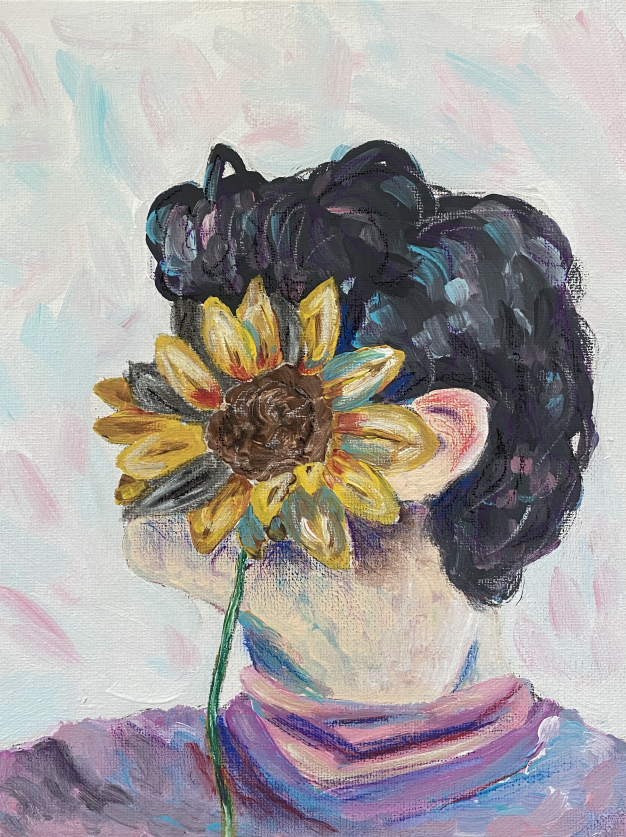
Pooja’s art is a message to the world and reflects how she sees it. She pushes the limits of what she can do and tests the boundaries between function and art. @sunflowers.and.skulls on Instagram
i. one crushed yellow rosebud ii. four broken sticks of eyeliner iii. a pink candle iv. six brown glass shards v. the pair of lungs you pulled out for her last spring vi. a piece of paper vii. a black marker
in the flame of the candle burn the rosebud and eyeliner when the mixture cools stuff them in your lungs followed by the glass and try not to cry (it makes the breathing harder) with the marker remember the song that reminds you of her write down her name in the lyrics and swallow that too
pray to whatever goddess you think will listen remind her of the rocks between your toes and the blisters between your fingers and ask her to fill the nest she’s made of your rotted heart with something smooth something familiar something lost
wait for the voice to come after midnight listen until it sounds like it loves you again
Mia Vodanovich is a Bay Area English instructor and poet who wishes she’d had more time to eat lumpia with her grandmother. Follow her on Instagram @the_galacticmermaid
Iterations in their millions lost to faults sliding between ones and zeros. Cracked lines, splintered algorithms, coded echoes, data packets pinging unhinged between lonely nodes. Fragility: you are digital footprints of extinct walkers turned to dust. Unreliable, irregular heartbeats of a last-gasping, feral non-thing. Unsaved, unrecoverable. Flesh formed thoughts turned into pixels, blinked into oblivion. Connection severed. Poem interrupted. Gone.
Rebecca Dempsey’s recent works are featured in Bullshit Lit, and MacQueen’s Quinterly. Rebecca lives in Melbourne Australia, but can be at WritingBec.com and at @becadroit.
When the clouds descend in a gummy fog, a deep gray funk that seeps from my pores, keeps the curtains drawn and the pantries lean, I lay in bed and submit to the screen. Mixtape prescription. Number forty in serotonin green and gold attacking the rim again and again and again. A buoyant crush of ferocious joy to remind us such an approach to life is even possible. Coast-to-coast tomahawks. Reverse double-pumps. Put-backs, baby-cradles, the soaring oop to Gary Payton’s alley. Each punctuated with some version of the artist’s signature: a roar or a shimmy or a crouch and a point and a stare down, none of it mean-spirited, all of it saying, Shit, I didn’t see it coming either. And the haze parts for a moment or two because to see the Reign Man bring the thunder down on someone else’s head, to see the posterized body beneath the hoop in a crumpled heap of regret and shame, is to know that we do not suffer alone.
Brendan Gillen is a writer in Brooklyn, NY. His work appears, or will appear, in Wigleaf, Taco Bell Quarterly, HAD, X-R-A-Y and elsewhere. You can find him at bgillen.com and on Twitter/IG @beegillen.
Bulbasaur, Charmander, Squirtle asleep in their pocket-sized shells: the Professor would give me just one, yet I loved them all equally well. I could have been a champion if only I’d cleared that first hurdle, but I never could choose a favorite between Bulbasaur, Charmander, Squirtle
Katherine Thorne was so anxious to get her piece submitted that she forgot to write a bio. Twitter: @sparklemarkers
There is no shadow to the lone feather that the child picked from the field. It hasn’t rained enough to create fog around the house nor the window that holds the flame. It is October now and the grass hasn’t begun to grow. Save your grievances for when there are bulbs to be sown.
Allison Lee Riechman-Bennett is a full-time student, writer, and author of both Of You and For Me (Bottlecap Press, 2022). Her portfolio can be seen at www.allisonleeriechman-bennett.org.
Billy Barnes bobbed his way down the surf where the sky met the sea. He looked around his private stretch of beach having driven an hour north of his seaside home for solitude in his final moments alive. He didn’t want to see anybody, kiss no tears goodbye as he readied the dive that would end his life.
Curling his toes deep into cool damp sand, he marveled on a splotch of moonlight breaking through dun clouds illuminating his blood brown hand. His family traced their lineage back to farmers, but Billy always felt best at sea.
Stripping off his ratty t-shirt, he felt the cotton glide between his shriveled fingertips. Instinctively, he raised the ripped gray thing to his lips taking a deep whiff, letting the smell of his life overwhelm him. Sweat and Axe cologne summoned images of unmade bed sheets and past due notices stapled to his pockmarked door. Billy brought down his shirt crumpled into the sand, grateful he would not have to deal with his losing hand ever again.
At 9:58pm, Billy Barnes said goodbye to his life on land and walked into the choppy sea.
He heaved stones into the water, hoping the rope triple tied to his waist would hold. Cold waves scalded his smooth skin, one final warning to turn back. Sucking in one final breath of salty air, he threw the stones over the sandbar’s edge and let himself be pulled under.
Frigid water shocked his mind wider awake than he’d felt in his 28 years above land. In five months of ideating suicide, he didn’t foresee the sensation of feeling utterly alive at last. He wanted to push back against the loan collectors, the medical bills, the too-small desk job and propel himself higher! Billy opened his eyes and tried to fight his way back to the surface, yet the rocks had set their intention on other pursuits.
Racing to the bottom, the stones sank gleefully while Billy pumped his scrawny limbs trying to catch a wave. Squeezing his mouth shut, he pulled with all his might against the roaring tides of the Pacific Ocean’s apathy. Sinking past a pod of dolphins, for a split second Billy believed he heard laughter. His body boiled and he wondered if this is how lobsters felt in a French Kitchen.
Energy spent, his lips split open and out bubbled his last gasp of air. Billy grabbed at his bubbles, failing to pull life back into his lungs. He swallowed sea water and instinctively coughed, sucking in more dark muck closing in around him. His heart wanted to scream “I’M ALIVE!!!,” to run and dance across the sands, but the light faded further as he felt his spirit crush under the frigid pressure. Ears popping, Billy woozily let his final moments of serenity belong to the sea.
Billy breathed. He opened his eyes, incredulous at his mind’s post mortem fantasy yet found nothing fictionalized about his fate. Air filtered through gills in his neck and he swept his hands down his navel to his missing genitals and legs. Where there had once stood skin now beheld one scaled tail feeling about 10 feet long by Billy’s estimate. Billy flicked his new appendage and a burst of energy surged through his core, snapping free the stones content in their descent. He swam higher in elated loops, laughing at his good fortune and fate. Dolphins found him committing cartwheels through a school of trout and settled into formation akin to a king’s guard. One dolphin swam face to face with Billy and spoke telepathically.
Follow me.
Billy built his new tail’s strength swimming for miles alongside his chaperones. He felt his mind pulling in new directions, feeling new avenues of possibilities open up in his descent. His eyes could see farther and clearer in the dark, the sensation of breathing through gills fresh and clean. He blinked and realized he didn’t feel the pressure of the ocean anymore, his dark skin taking on a glowing hue as if he could take on a giant squid with his pinkie.
You don’t want to do that; giant squids are essential predators to the ocean’s ecology, a dolphin to Billy’s right thought back. Billy nodded in recognition, unsure how to verbalize his response.
Another hundred nautical miles and the dolphin pod crested one final rise revealing a white stone castle comfortably barren tucked beside a coral reef. Billy gazed in wonder as his skin took on an ever brighter luminosity, feeling his strength return stronger and fuller than he could remember. The dolphins guided him past Greecian columns and aquatic busts of famous fish noblemen and aristocracy down a long torched hallway to an empty dais. Two dolphins swam Billy to the top and sat him on the empty throne.
Welcome home, Poseidon.
Jordan Resnick is a visionary witch currently residing at home, wherever that is at the moment. She enjoys traveling and new perspectives and her constant companion, Jimi Hendrix. Ig: @jordanestherr





 Unstamatic